



Solving a $30,000 Credit
Union Fraud Case




Solving a $30,000 Credit Union Fraud Case
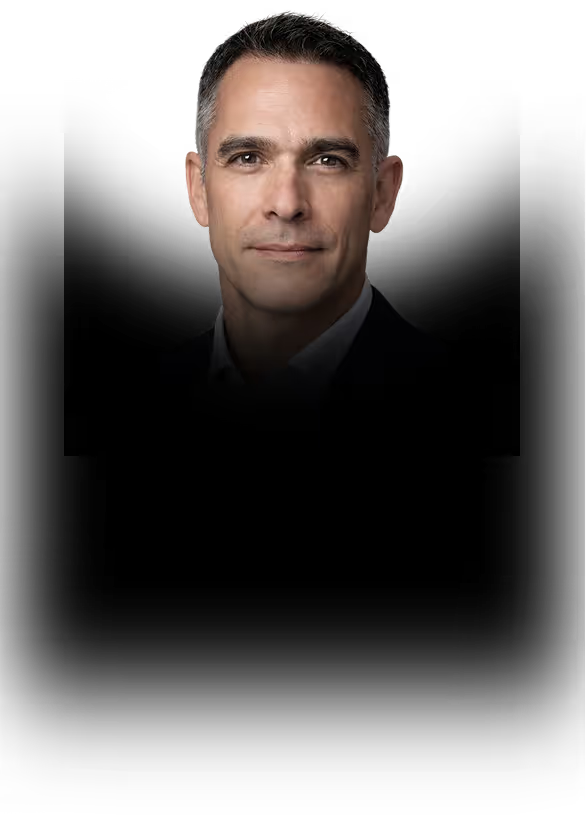
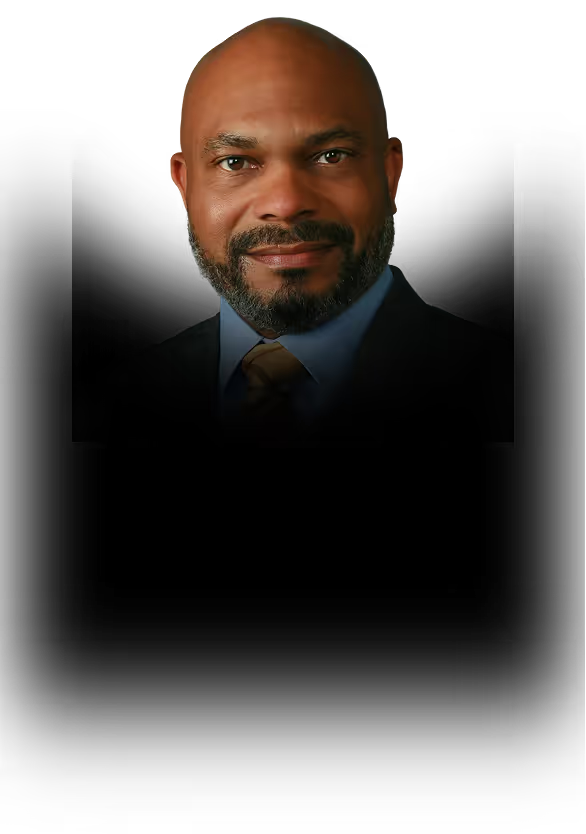
This session walks through a real-world $30,000 credit card fraud investigation that turned into a model of collaboration and compliance in action.
What began as a suspected fraud case at a Las Vegas casino quickly evolved into a cross-industry effort leveraging FinCEN’s 314(b) platform, compliance insights, and law enforcement partnerships.
Attendees will learn how behavioral analysis, quick coordination, and professional networking led to a swift resolution and uncovered a first-party fraud scheme at the Credit Union.
R US
Inside the New Global
Deepfake Fraud Factory




R US
Inside the New Global Deepfake Fraud Factory
Dark web marketplaces, low-cost AI tooling, and new injection vectors have turned generative media into a fraud accelerator.
This session shows real life examples of these attack vectors using controlled, ethical demos, and — most importantly — delivers real, implementable prevention and detection strategies for individuals and organizations.
Walk away able to spot likely abuses, harden controls, and specific takeaways that you can include in your strategy to combat deepfakes.
FRANK
Why The USPS is Choosing Not to Stop Mail Fraud




Why The USPS is Choosing Not to Stop Mail Fraud
It’s no secret that The United States Postal Service (USPS) is a breeding ground for fraud.
What is a bit surprising is that the USPS can do something about it, but chooses not to. In an exclusive, no-holds-barred interview, Frank McKenna talks with Frank Albergo, National President of The Postal Police Officers Association. McKenna will discuss with Albergo on how mail theft spiraled out of control and why it continues to get worse.
He’ll press Albergo on pulling back the curtain with what’s happening behind the scenes and how the fix is already within the USPS’s grasp. This is a rare, candid look at one of the most underreported fraud pipelines in America and a session you won’t want to miss.
The AirKey and Capital One
Story




The AirKey and Capital One Story
Innovation inside a bank is a marathon, not a sprint. Go behind the scenes of AirKey, Capital One’s card-tap technology that transforms bank cards into NFC hardware authenticators.
FI's will learn how fostering long-term innovation can lead to tangible outcomes. AirKey was born in 2017 and launched publicly in 2024, supported by a partnership with Prove. This has led Capital One to experience a 60% drop in digital wallet fraud and a 50% reduction in high-risk transaction fraud. With 100 million cards in the market, AirKey demonstrates how to scale internal breakthroughs.
Attendees will explore the realities of corporate innovation and why the juice is worth the squeeze.
to Practice
Evidence-Based Research & Fraud Prevention



Evidence-Based Research & Fraud Prevention
Fraud prevention works best when decisions are driven by evidence, not assumptions. This session introduces an evidence-based approach and shows how real data from the online fraud ecosystem can be operationalized.
Researchers from the Evidence-Based Cybersecurity Research Group (EBCS) at Georgia State University demonstrate how fraud actors advertise, coordinate, and exchange services online, and how systematic data collection generates early warning signals for financial institutions. The session closes with a practical case study on the link between check theft and identity theft in the United States, showing how evidence-based frameworks uncover connections between fraud types and strengthen detection, investigation, and prevention strategies.
SHARING
Finally, Advice I Can
Act On








SHARING
Finally, Advice I Can
Act On
Waiting on regulators to clarify data sharing to make your lawyers happy is not working. Buckle up. This rapid-fire, forty-minute session is split into two parts.
First, Matt O’Neill and Greg Williamson skip the “if only FinCEN drafted clearer language” talk and get straight to the low-hanging fruit — bank-to-bank data you should have been sharing already.
Then Jim Hitchcock and Steve Gutierrez take the stage to tackle the same challenge with law enforcement: what data can be shared now, what best practices work, and how to speak the same language. Let’s stop kicking this topic down the road and actually do something. This session won’t give you a perfect template — it delivers easy wins and pushes you to act.
Defining Moment
Why It Pays to Make It Right


Why It Pays to Make It Right
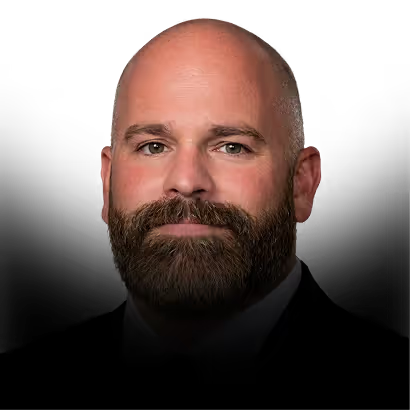
Fraud is often treated as a cost to manage. For Joseph McLean, CEO and Co-Founder of Quavo, it’s a defining moment where trust is either restored or lost.
In this keynote, Joseph shares how his journey from fraud investigator to entrepreneur reshaped his view of fraud and disputes as opportunities to do right by customers.
He explores what the industry gets wrong about “making it right,” how fragmented processes drive hidden costs and erode trust, and why the real cost of fraud goes beyond dollars lost. Drawing on Quavo’s founding insight, Joseph shows how data-driven approaches can align fairness, performance, and growth—reframing fraud as a strategic moment that defines the customer relationship.
Where Innovation Meets the Market


WHERE INNOVATION MEETS THE MARKET
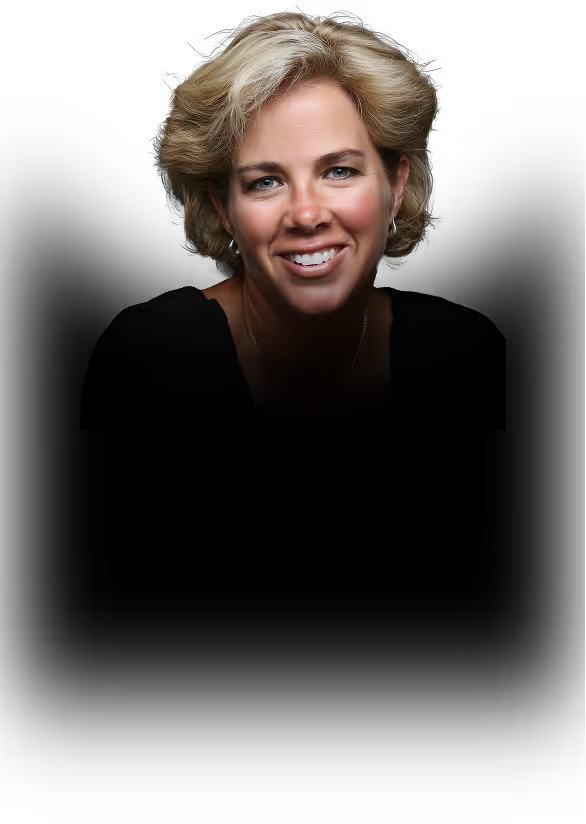
Get ready for one of the most dynamic sessions of the conference. The Pitch brings five innovative startups to the stage, each with one mission: convince the audience that they are the most promising solution in the market.In a fast-paced, high-energy format, each startup will present its vision, product, and market impact. Our two hosts Donna Turner and Miguel Navarrowill challenge the founders with sharp questions — diving deeper into business models, scalability, differentiation, and real-world results.
No scripted panels. No generic presentations. Just bold ideas, honest answers, and direct insights.
And then it’s your turn. At the end of the session, the audience will vote live to crown the winning startup




Generative AI gets plenty of attention as a fraud risk. But what happens when fraud and AML teams turn it into a tool?
In this session, leaders from large financial institutions and fintechs share how generative and agentic AI are already showing up inside real fraud and AML workflows — helping teams move faster by automating investigation steps, prioritizing alerts, and supporting reviews across onboarding, transactions, and ongoing monitoring. Just as importantly, they call out where human judgment still rules, from edge cases to high-risk decisions. We’ll close with a look at what’s working today, what’s not, and how teams expect fraud and AML operations to evolve as agentic AI moves from experiment to production.
& ACH Abuse:
A Fraudster’s Playground



A Fraudster’s Playground
ACH debit abuse and first-party fraud have reached a tipping point. With 60-day return windows, minimal investigations at intake, weak onboarding controls, and limited data sharing between institutions, bad actors are exploiting the gaps.
This session tackles the hard questions: What is Nacha seeing across the network and how can RDFIs, ODFIs, vendors, and Nacha form a unified front to challenge questionable claims while staying compliant? Stacie and Devon will answer these questions while sharing battle stories and practical solutions. Things like smarter onboarding and KYC, better monitoring of unauthorized return rates, actionable data sharing, and stronger collaboration across the ecosystem.

Tracy Hall takes audiences inside an 18-month relationship built on love, credibility, and careful manipulation—before it collapsed in a single moment with a Crime Stoppers video and a $317,000 loss. What emerges is not just a personal story of intimate fraud, but a forensic look at how trust is engineered, groomed, and weaponized.
Drawing from her lived experience and the investigation that uncovered decades of global deception, Tracy explains the psychological tactics that bypass the belief that “it would never happen to me.” She connects her story to the industrial scale of modern fraud—from pig-butchering syndicates in Southeast Asia to AI-driven sextortion schemes.This keynote challenges audiences to rethink fraud resilience not only as a systems issue, but a human one—ending with a practical call to action to strengthen awareness, recognize vulnerabilities, and build financial and digital resilience in an increasingly deceptive world.
the Dark Arts:
How AI is Shaping Fraud Prevention


How AI is Shaping
Fraud Prevention
In an era where deepfake attempts have skyrocketed 2,137% and AI-generated phishing is now 4.5× more effective than human-crafted attacks, the financial crime landscape has shifted into a high-stakes AI arms race. This session dives into the trenches of modern fraud, exploring how bad actors weaponize voice cloning—up 680% in the last year alone—and how data scientists can "fight fire with fire" using advanced ML models and defensive technologies. We’ll move beyond the headlines to discuss data strategies and techniques required to harden your defenses, ensuring your fraud program doesn't become the "hobbling antelope" of the pack in this rapidly evolving threat environment.
Killing the Cross-Sector
Fraud Loop




Identity OS:
Killing the Cross-Sector Fraud Loop
Fraud doesn’t happen in a vacuum, yet defenses remain siloed. Today, fraud rings can use AI to create thousands of “trusted” bank accounts—later weaponized for scams or mule networks. The problem is treating identity as a one-time check.
To counter this, we need an Identity Operating System for the Internet.Identity must move beyond static PII to a living composite of digital footprints, behavior, and transaction history—connected in a unified global view. In this session, we’ll analyze cross-border, cross-sector attack patterns and show how fraud rings leave identifiable digital signatures as they move between industries.
You’ll see how a unified Identity OS reveals these hidden links, enabling institutions to recognize patterns early and neutralize fraud networks at scale. The goal: stop chasing individual transactions and start dismantling the fraud economy.

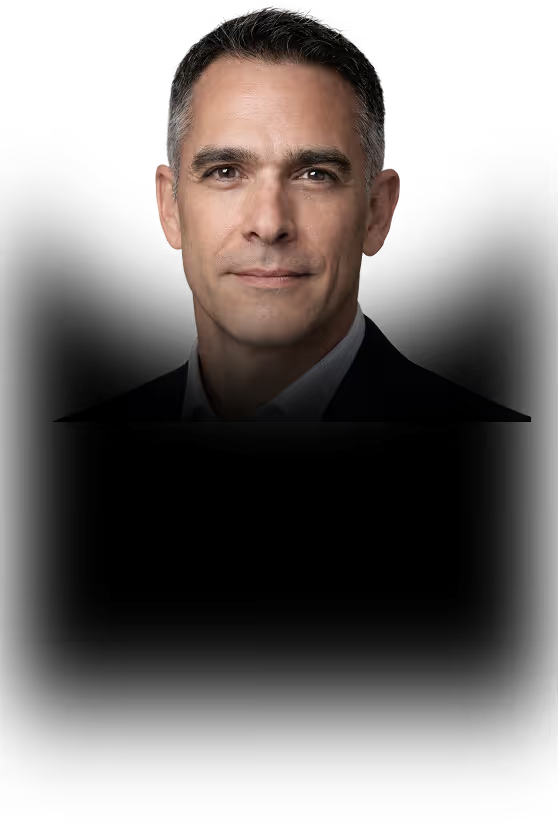
in Fighting Elder Fraud

New Scam Education Kit


Disrupt Organized Scams

Ask Them (just about) Anything




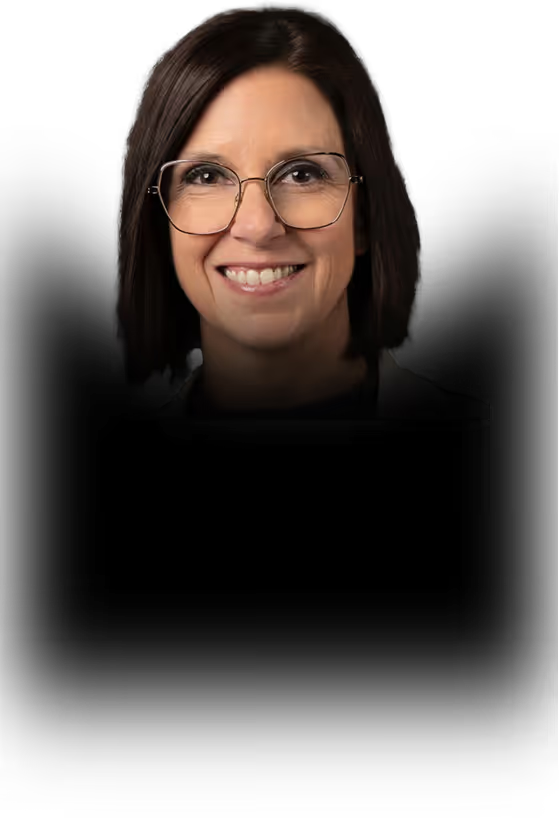

Ask Them (just about) Anything
We've gathered leaders across payment rails and countries to hit them with your most pressing questions about fraud & scams.
Donna Turner will moderate the crossfire, launching questions of her own. But then, we'll turn to the audience for their inquiries. If you could do one thing differently for your FI/Network right now to make the scam fight more effective, what would it be?If you could ask Congress/Parliament to do one thing in this fight right now, what would it be?If you could ask Meta to do one thing differently right now, what would it be? Direct questions. Hard questions. Honest answers. Oh, and make sure you brainstorm some questions of your own!